
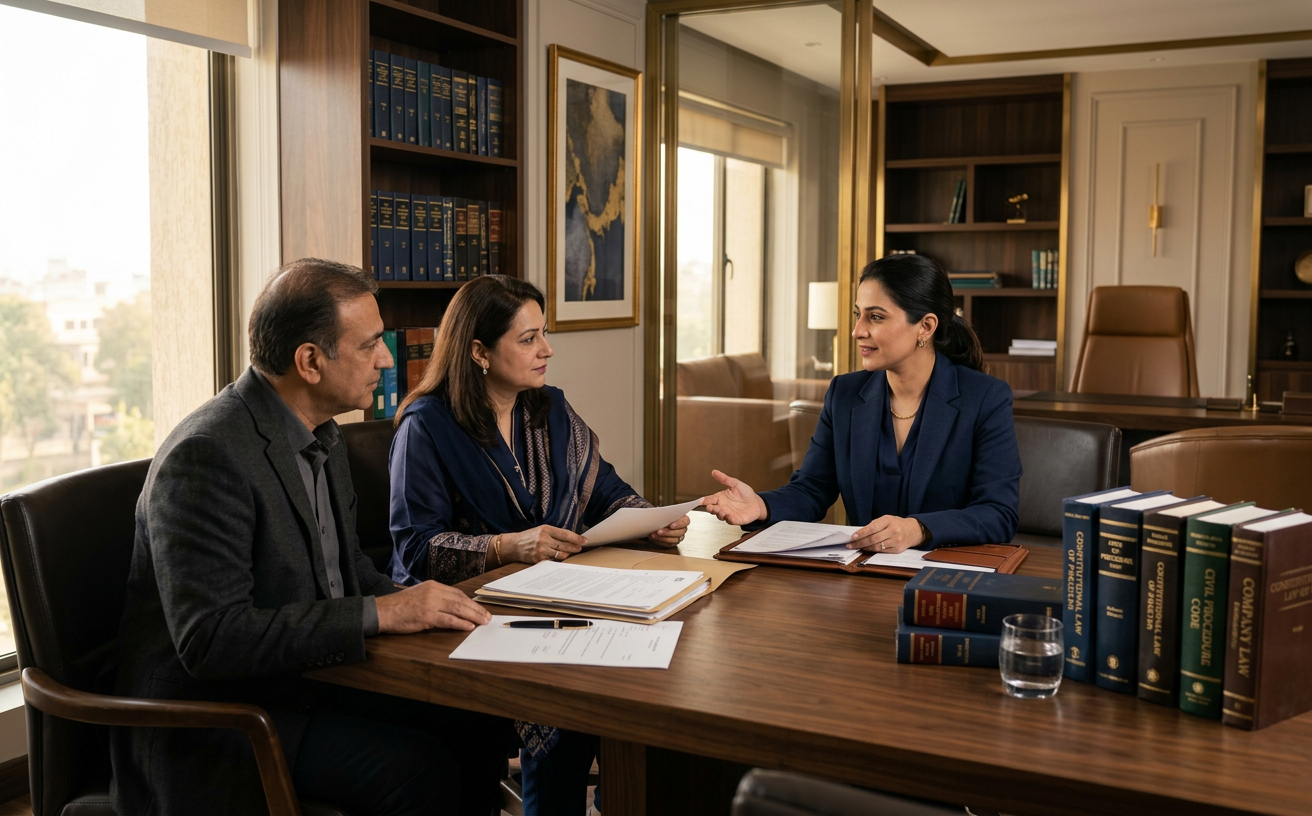
Divorce And Khula Lawyers In Pakistan: Legal Overview
Family matters can involve personal status, children, maintenance, dower, dowry, guardianship, visitation and court procedure at the same time. The legal route should be selected after reviewing the family record, current proceedings and immediate risks.
Case Assessment And Legal Instructions
Legal representation for divorce, khula and related family court matters. Right Law Associates begins by identifying the applicable law, jurisdiction, documents and practical objective. Advice should be based on the actual record rather than a general assumption about similar matters.
Family Law Team By Region
Relevant Lawyers Without Guessed Portraits
Karachi: Shankar Lal Kataria for family and matrimonial matters; Mohsin Ali Mirani for connected civil and family litigation; Zaheer Ashraf Qazi for Right Law family-law coordination; and Sobia Mohsin for family, matrimonial and documentation matters.
Islamabad And Rawalpindi: Kashif Mumtaz, Advocate High Court, for local family-law representation and coordination.
Lahore: Junaid Kahloon, Advocate High Court, for local family-law matters.
Senior And Appellate Matters: Akhtar Rizvi, Advocate Supreme Court, is referenced only where senior or appellate involvement is genuinely relevant. Fayyaz Khan, Advocate Supreme Court, may be relevant for higher or appellate matters in Lahore, Islamabad and Multan.
Verified portraits are displayed only where an authorised site asset clearly identifies the correct lawyer. Otherwise, the profile remains text-only.
Divorce And Khula Lawyers: Start With A Case Assessment
Identify The Objective, Forum And Immediate Risk
A divorce or khula case should begin with a focused assessment rather than a standard petition. The lawyer needs the marriage record, present residence of both parties, any children, financial claims, previous notices, existing court cases and the client’s immediate objective. Urgent issues such as safety, access to children, maintenance or threatened disposal of property should be identified at the first consultation. Right Law Associates uses this initial review to separate the marriage-termination issue from connected claims and to prepare the correct litigation or documentation plan.
Khula Petition Drafting And Family Court Representation
Build The Pleading Around Accurate Facts And Documents
A khula petition should state the marriage particulars and relevant facts clearly, without unnecessary allegations that do not assist the court. Accurate addresses are important for service and delay can result where parties or records are wrongly identified. The legal team should review the Nikah Nama, CNIC records, any prior correspondence and connected family proceedings before filing. During the case, clients should keep copies of summons, orders and hearing dates and inform counsel promptly about any new development affecting settlement, children or financial claims.
Divorce Documentation For Husband-Initiated Talaq
Coordinate Notice, Administrative Record And Certificate Work
Where a husband initiates talaq, legal assistance may involve reviewing the written notice, the competent Union Council or local authority, service evidence and the later documentary record. The legal team should ensure that names, addresses and marriage particulars are consistent with the Nikah Nama and identity records. Clients should retain proof of submission and all authority correspondence. A later divorce certificate should reflect a properly completed underlying process; certificate work should not be used to conceal or bypass a missing legal step.
Connected Family Claims During Divorce Or Khula
Plan Maintenance, Dower, Dowry And Child Issues Early
Marriage termination may occur alongside maintenance, dower, dowry-article, custody, guardianship or visitation disputes. These issues should be mapped at the outset so that documents and evidence are not lost while attention is focused only on the divorce decree. Financial claims may require proof of agreed Mahr, payments, household expenses, income or ownership of articles. Child-related claims require a separate welfare-focused assessment. A coordinated litigation plan can reduce contradictory pleadings and help the client understand which issues can be resolved together and which need distinct proceedings.
Evidence, Hearings And Settlement Strategy
Preserve The Record And Document Any Compromise Carefully
Family cases often turn on the quality of the record as much as the allegations made. Preserve original documents, reliable copies, messages, payment evidence and earlier orders. If settlement discussions occur, the proposed terms should clearly state what is resolved and what remains pending. Agreements concerning dower, maintenance, custody, visitation or property should not be left to vague oral understandings where enforceability may later matter. Counsel should also explain the effect of withdrawing, compromising or not pursuing a pending claim before the client signs a statement.
After The Decree Or Completion Of Talaq
Finish Registration, Enforcement And Future Documentation
Obtaining a decree or completing the talaq process may be only one stage. The client may still need certified copies, Union Council records, a divorce certificate, enforcement of financial relief or follow-up concerning children. Overseas clients may require attestation, translation or additional verification according to the receiving authority. The legal team should compare all final documents for consistent names and dates and advise which originals should be retained. A complete closing file reduces difficulty if remarriage, immigration, inheritance or later litigation requires proof of marital status.
Key Issues In Divorce And Khula Lawyers In Pakistan
The following issues should be reviewed separately where necessary:
- Case Assessment: documents, procedure, remedies, risk and the correct forum should be checked before action is taken.
- Khula Petition: documents, procedure, remedies, risk and the correct forum should be checked before action is taken.
- Talaq Documentation: documents, procedure, remedies, risk and the correct forum should be checked before action is taken.
- Maintenance Claims: documents, procedure, remedies, risk and the correct forum should be checked before action is taken.
- Dower and Dowry: documents, procedure, remedies, risk and the correct forum should be checked before action is taken.
- Court Representation: documents, procedure, remedies, risk and the correct forum should be checked before action is taken.
Planning The Matter Before Filing Or Registration
Prepare a concise chronology, identify the desired outcome and separate confirmed facts from assumptions. This helps determine whether the matter requires litigation, an administrative application, registration work, a legal notice, negotiation or a combination of steps.
Documents And Evidence
Relevant records may include CNIC copies, certificates, agreements, notices, court orders, registration records, correspondence, financial documents and other evidence. Originals or reliable copies should be reviewed before pleadings, applications or formal advice are prepared.
Record Discrepancies Before Filing
Where a record contains an error, inconsistency or outdated entry, identify it before filing. Correcting the underlying record can sometimes be as important as the main legal proceeding.
Procedure, Jurisdiction And Timing
The correct court, tribunal, authority or registration office depends on the subject matter and facts connecting the dispute to a place. Filing in the wrong forum can cause delay, additional expense or dismissal. Jurisdiction, limitation and the relief required should be checked first.
Urgent Applications And Deadlines
Urgent cases may require interim relief such as an injunction, stay, interim custody, preservation direction or another temporary order. Deadlines, notice periods and sequence can materially affect the result.
Legal Route Comparison
| Route | When It May Apply | Check First |
|---|---|---|
| Court Proceeding | Rights are disputed or an enforceable judicial order is required. | Jurisdiction, limitation, parties, pleadings and evidence. |
| Administrative Or Registration Route | The matter concerns an official record, certificate or statutory authority. | Underlying record, identity details and authority requirements. |
| Negotiated Resolution | The parties can lawfully resolve the dispute without a full trial. | Terms, enforceability, waivers and future obligations. |
How Right Law Associates Handles These Matters
Our process begins with factual and documentary review. We identify the legal issue, check the available record, explain the route and then prepare the required documents or representation strategy. A negotiated or administrative solution may be considered before contested proceedings where legally appropriate.
Legal Team And Regional Coordination
Right Law Associates works with clients in Karachi, Islamabad, Rawalpindi, Lahore and other parts of Pakistan through the relevant legal team. Overseas Pakistanis can provide initial documents electronically where the matter permits remote coordination.
Our Legal Review Process
| Stage | Focus | Output |
|---|---|---|
| Initial Review | Facts, chronology, documents and immediate risk. | Issue list and missing-document checklist. |
| Legal Strategy | Forum, law, relief, notices and evidence. | Recommended route and filing plan. |
| Execution | Drafting, filing, representation and follow-up. | Documented next steps and coordination. |
Related RightLaw.pk Legal Guides
These pages provide more specific guidance on connected issues:
Authoritative And Specialist Resources
Official Sources And Relevant Legal References
Trusted Legal Resources And Internal References
For connected information, readers may also review Qanoon House, Qanoon Online, Karachi Lawyers and, for marriage procedure, Court-Marriage.com.
Frequently Asked Questions
Do I Need A Lawyer For Divorce And Khula Lawyers In Pakistan?
Legal advice is useful where rights are disputed, a court order is required, documents conflict, a deadline applies or the matter may affect future legal status.
Can The First Consultation Be Handled Remotely?
Many matters can be reviewed initially by phone, WhatsApp or electronic documents. Personal appearance may still be required depending on the court, authority or procedure.
How Long Does The Procedure Take?
Time depends on the forum, complexity, service of notices, evidence, objections and whether the matter is contested. A reliable estimate requires review of the specific file.
What Documents Should I Send First?
Send a short chronology, identity documents and the records directly connected with the dispute, transaction, registration or application. Clear scans are usually enough for an initial review.
What If My Documents Have Different Names Or Dates?
The discrepancy should be identified before filing. Depending on the record, correction, clarification, affidavit or another formal step may be required.
Which Court Or Authority Has Jurisdiction?
Jurisdiction depends on the type of matter, location, residence of the parties, property or transaction involved and the relief requested.
Can Urgent Interim Relief Be Requested?
Where the law permits, urgent relief may include an injunction, stay, interim custody, preservation direction or another temporary order supported by evidence.
How Are Legal Fees Determined?
Fees depend on complexity, forum, expected hearings, drafting requirements, evidence and whether the work is advisory, administrative or contested litigation.
Can Overseas Pakistanis Start Remotely?
Many matters can begin remotely through electronic document review. Some proceedings may later require attested authority, couriered originals or personal appearance.
Do I Need Original Documents?
Copies can often be used for initial review, while originals, certified copies or attested records may be required for filing, verification, evidence or registration.
What Happens If The Other Party Does Not Cooperate?
The available route may include formal notice, court proceedings, substituted service, administrative action or another remedy depending on the facts and law.
Can The Matter Be Settled Without Full Litigation?
Some matters can be resolved through negotiation, corrected documentation, consent terms or an administrative route, but the settlement should be properly documented and enforceable.
What Should Be Checked Before Filing?
Check limitation, jurisdiction, necessary parties, prior proceedings, notice requirements, available evidence and the exact relief required.
Can An Earlier Order Affect The Current Matter?
Yes. Earlier orders, registrations, contracts, notices, certificates and pending proceedings can affect jurisdiction, strategy and available remedies.
How Important Is Documentary Evidence?
Documentary evidence can be decisive. Preserve agreements, official records, notices, receipts, correspondence, identity documents and prior orders in their original form where possible.
Should I Sign A Settlement Without Advice?
A settlement may waive rights or create obligations that are difficult to reverse. Its legal effect and enforcement mechanism should be understood before signing.
What If A Limitation Period May Apply?
Seek advice promptly because some claims, appeals, notices and applications are subject to strict time limits.
Can Connected Issues Be Coordinated?
Often yes, but connected issues may still require separate applications, authorities or forums even when they arise from the same facts.
Does Right Law Associates Handle Matters Outside Karachi?
Right Law Associates coordinates matters through legal teams and associated counsel in Karachi, Islamabad, Rawalpindi, Lahore and other jurisdictions where appropriate.
How Do I Start A Divorce And Khula Lawyers In Pakistan Matter?
Send the city, a concise summary, the current procedural stage and the key documents so the legal team can identify the lawyer, missing records and next practical step.
Editorial Responsibility — Advocate Sobia Mohsin
Professional Context And Case-Specific Advice
This page provides general legal information within the Right Law Associates editorial process. Case-specific advice requires review of the actual facts, documents, jurisdiction and current procedural position.
Discuss Divorce And Khula Lawyers In Pakistan With A Lawyer
Contact Right Law Associates with the city, a short summary of the matter and the key documents available.
Contact Right Law Associates